
New York City Property Records
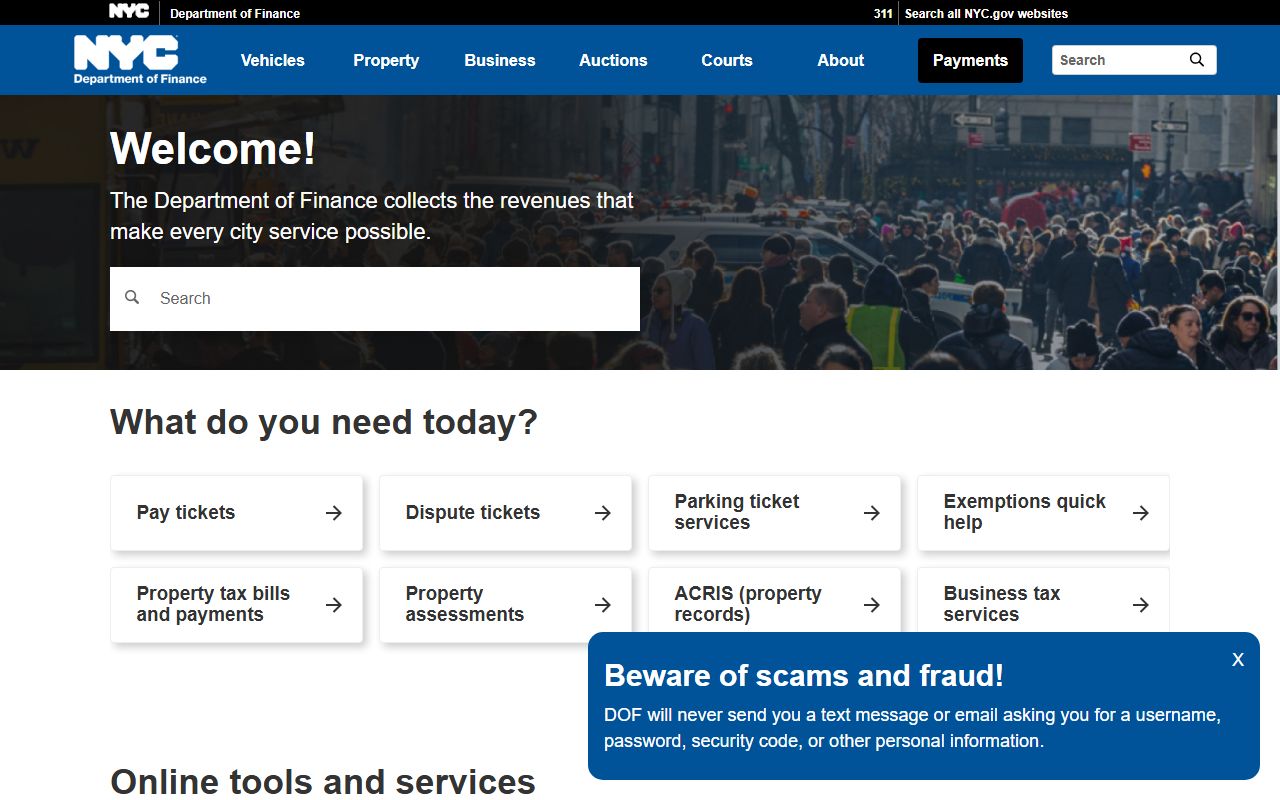
New York City property records cover five boroughs and millions of parcels, making it the largest local property records system in the state. The NYC Department of Finance operates the Automated City Register Information System, known as ACRIS, which provides free online access to deeds, mortgages, and liens recorded from 1966 to today. Property records in New York City also include assessment rolls, tax maps, building permits, and certificates of occupancy maintained by multiple city agencies. Whether you need to look up a deed in Brooklyn, check a mortgage in the Bronx, or find assessment data for a Queens property, the city offers several online tools at no cost.
New York City Property Records Overview
Which Counties Handle New York City Property Records
New York City spans five counties. Each borough is its own county. Manhattan is New York County. Brooklyn is Kings County. The Bronx is Bronx County. Queens is Queens County. Staten Island is Richmond County. For most boroughs, the NYC Department of Finance handles property recording through the City Register. Richmond County is an exception. Staten Island property records go through the Richmond County Clerk rather than ACRIS.
Despite having five counties, New York City centralizes much of its property records management. The Department of Finance oversees assessment, collection, and recording of real property documents across all boroughs. Each borough still has its own City Register office for in-person services. Manhattan's office is at 66 John Street. The Bronx office is at 3030 3rd Avenue, Room 280. Brooklyn is at 210 Joralemon Street. Queens is at 144-06 94th Avenue in Jamaica. Staten Island uses the Richmond County Clerk at 130 Stuyvesant Place.
How to Search New York City Property Records
The primary search tool is ACRIS. It covers Manhattan, the Bronx, Brooklyn, and Queens. No registration is needed. You can search by address, owner name, Borough-Block-Lot number, or document type. Electronic copies of documents can be downloaded at no charge when you print from your own computer. Certified copies cost $4 per page and must be requested in person or by mail. Documents before 1966 are not in ACRIS and must be searched at the City Register offices.
The Property Information Portal is another free tool from the Department of Finance. It shows an interactive digital tax map with lot lines, block and lot numbers, street names, and easements. You can search by address, intersection, or common place name. Certified tax maps cost $10 each when ordered online. Uncertified copies are $1 per page at the Tax Map Office on the 2nd floor of 66 John Street in Manhattan. Free copies can be printed from your own computer.
For building records, the Department of Buildings Information System lets you look up permits, violations, complaints, and certificates of occupancy. You can search by Building Identification Number, block and lot, or address. A newer system called DOB NOW covers filings from 2020 onward. Both are free to use. The NYC 311 service also provides information about how to get copies of deeds and update ownership records.
Recording Fees and Property Taxes in New York City
Recording a deed in New York City requires several fees and forms. The base recording fee is $45 plus $5 per page. A TP-584 Combined Real Estate Transfer Tax Return costs $5 to file. The RP-5217 Real Property Transfer Report is $125 for qualifying residential or farm property and $250 for other types. New York State transfer tax runs $2 per $500 of consideration (0.4%). Residential deeds also carry an additional $10 fee per Real Property Law Section 291.
New York City adds its own transfer taxes on top of state fees. The city's Real Property Transfer Tax (RPTT) ranges from 1% to 2.625% depending on the property type and sale price. The so-called "Mansion Tax" applies at 1% for residential properties selling for $1 million or more. This is paid by the buyer. Mortgage recording tax in New York City includes the state rate of $0.50 per $100 of debt, plus city rates of 1% for mortgages under $500,000 on 1-3 family homes and individual condos, or 1.125% for all other properties. Additional MCTD tax also applies since all five boroughs fall within the Metropolitan Commuter Transportation District.
ACRIS has a built-in calculator for computing transfer taxes and mortgage recording taxes. You can use it to figure out exact costs before recording. Form MT-15, the Mortgage Recording Tax Return, must be filed along with the recorded mortgage. All documents must have original signatures and proper notary acknowledgments per Real Property Law Section 294.
Legal Framework for New York City Property Records
Property recording in New York City follows the same state laws as other counties. Real Property Law Article 9 establishes the framework. Section 292 states that unrecorded conveyances are void against later good faith buyers who record first. Section 293 gives constructive notice to all persons when an instrument is recorded. Section 319 requires the recording officer to note the time received, book and page, and any prior related instrument on each filed document.
The Freedom of Information Law (Article 6 of the Public Officers Law) guarantees public access to New York City property records. Agencies must respond to written FOIL requests within five business days, or 20 business days when they need more time. Copy fees under FOIL cannot go above 25 cents per page. Property assessment data, tax maps, and recorded land documents all fall under FOIL requirements. The Notice of Recorded Document Program lets property owners sign up for free alerts when documents are recorded against their property, helping fight real estate fraud.
New York City's Real Property Tax Law includes special provisions. Article 18 preserves class share of taxes, maintaining the balance of tax burden between different property classes. The city uses a four-class property tax system that treats residential, utility, commercial, and industrial properties differently. The STAR program gives school tax relief to eligible homeowners. Basic STAR is open to primary residences. Enhanced STAR helps seniors age 65 and older with income under statutory limits. The Department of Taxation and Finance now upgrades eligible Basic STAR recipients to Enhanced STAR automatically when they turn 65.
Additional New York City Property Resources
The New York State Office of Real Property Tax Services provides statewide property data, equalization rates, and municipal profiles that include New York City. The NYS GIS Clearinghouse offers parcel boundary data and interactive mapping for property research. The NYS Unified Court System gives access to foreclosure proceedings, quiet title actions, and judgment lien records through the eCourts system. eCourts allows free case tracking across Supreme Court and other courts.
Rolling Sales data from the Department of Finance shows recent property sales information for all five boroughs. The annualized list covers the prior 12-month period. This data is useful for comparable sales analysis and market research. NYC Department of Finance Property Records is the central page linking to all city property record tools and services.